Check your bolt heads! If you don't see '8.8' stamped on the top, you aren't getting high-tensile protection.
In the world of industrial container domes, most buyers focus on the fabric weight or the pipe diameter. However, there is a tiny component that holds the entire investment together: the bolt.
While the market is flooded with "budget" domes using Grade 4.8 bolts to slash costs, Toughcover Pacific insists on Grade 8.8 high-tensile hardware as a standard. Is this just an over-engineered detail, or does it truly matter? Here is a deep dive into the engineering reality of why this choice matters for your site.
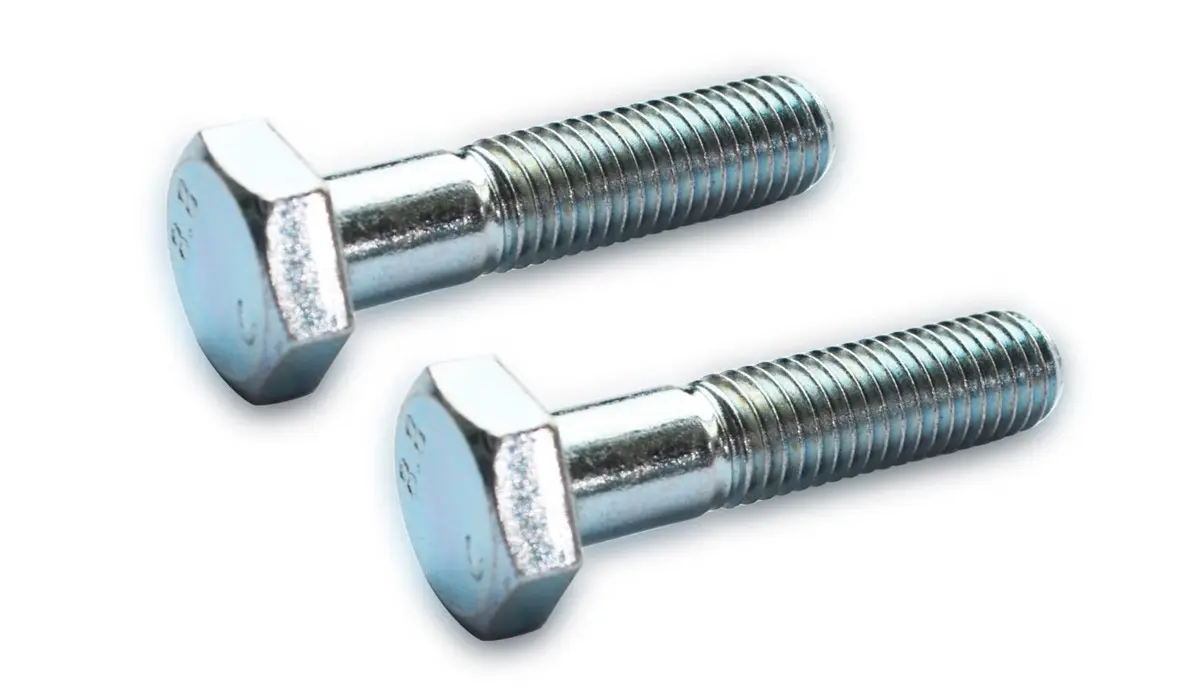
The numbers stamped on a bolt head are a code for its mechanical limits. The numbers "4.8" and "8.8" represent the mechanical properties of the steel. In engineering terms, moving from 4.8 to 8.8 isn't a small step—it’s a leap in performance.
● Grade 4.8: Made from low or medium carbon steel. It is "soft" steel, often used in furniture or light DIY applications.
● Grade 8.8: Known as "Structural Grade" or "High-Tensile." These bolts undergo a rigorous "Quench and Temper" heat-treatment process to alter their molecular structure for maximum toughness.Choosing Grade 8.8 means your connections can handle twice the load before the steel begins to stretch or snap.
Technical Property | Grade 4.8 (Industry Standard) | Grade 8.8 (Toughcover Standard) | The Gap |
Tensile Strength | 400 N/mm2 | 800 N/mm2 | 100% Increase |
Yield Strength | 320 N/mm2 | 640 N/mm2 | Double the Strength |
Material Class | Low or medium carbon steel | Medium carbon steel, quenched & tempered | Superior Toughness |
Vibration Tolerance | Low (Tends to loosen) | High (Maintains Torque) | Essential for Sites |
Choosing Grade 8.8 means your connections can handle twice the load before the steel begins to stretch or snap.
A container dome acts like a massive sail. When wind hits the structure, it creates immense "shear stress" and "vibration" at every connection point.
● Structural Integrity: Under high wind loads (common in Australian rural and coastal sites), Grade 4.8 bolts can stretch or shear. Once one bolt fails, the structural integrity of the entire arch is compromised.
● Vibration Resistance: Industrial sites are active environments. Constant wind vibration can loosen lower-grade hardware. Grade 8.8 bolts allow for higher torque during installation, ensuring the structure remains rigid for years.
● The Shear Risk: In a storm, the wind doesn't just pull the bolt; it tries to "scissor" it (shear stress). Grade 4.8 bolts are prone to "necking"—thinning out under pressure until they shear off.
In the Australian climate—from the salt air of Victorian coasts to the humidity of the north—rust is inevitable for low-grade steel. A bolt is only as good as its protection. Grade 8.8 bolts used by Toughcover are typically paired with high-quality galvanization. Because the base material is higher quality, the bonding of the protective layer is often superior, preventing the "rust-streaks" commonly seen on budget shelters after just one season.
● Hydrogen Embrittlement: Lower-grade bolts often have inconsistent zinc plating. Once rust enters the threads of a 4.8 bolt, the structural integrity drops exponentially.
● Long-Term Protection: Our Grade 8.8 hardware is precision-galvanized. Because the base metal is denser and stronger, it resists the "pitting" that leads to catastrophic bolt failure after 2-3 years of exposure.
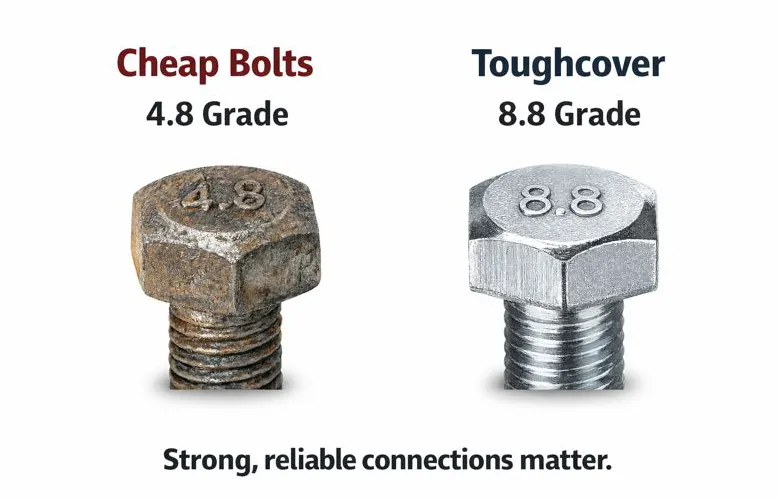
It is easy to hide cheap hardware inside a crate. By switching to Grade 4.8 bolts, a manufacturer can save thousands of dollars across a production run. Many competitors do exactly that to offer a "cheaper" price.
However, with over 20 years of manufacturing experience, we know what truly matters when the storm hits. We understand that a container shelter is often protecting hundreds of thousands of dollars in machinery or inventory.
✔ We don't cut corners because your peace of mind is worth more than a few saved cents on a bolt.
✔ We provide 2x FREE extra spanner kits in every package, not because installation is hard, but because we want you to have the right tools to secure our high-tensile hardware correctly.
For mining, agricultural, and commercial sites, compliance is a liability issue.
✔ AS/NZS 1170.2:2021: This Australian standard for wind actions is the benchmark for safety. An engineering certificate is often invalid if the hardware used does not meet the specified tensile requirements.
✔ Insurance Peace of Mind: If a "budget" shelter fails and causes damage to machinery or injury to staff, the first thing an investigator looks at is the quality of the components. Using Grade 4.8 bolts in a structural application can be seen as a failure of "duty of care."
✔ Toughcover’s 10-Year Warranty: We can offer a 10-year structural warranty on our frames because we know every bolt is rated for the task. We don't cut corners because we value your long-term productivity over short-term profit.
Choosing a Toughcover shelter means choosing an engineered solution where every detail—down to the last bolt—is designed for the harsh Australian climate. Don’t let your valuable assets rest under a "budget" frame. Invest in the strength of Grade 8.8.
Still have questions about wind ratings or hardware specs? Our Melbourne team is ready to help.