When creating covered storage between two shipping containers, there are generally two approaches.
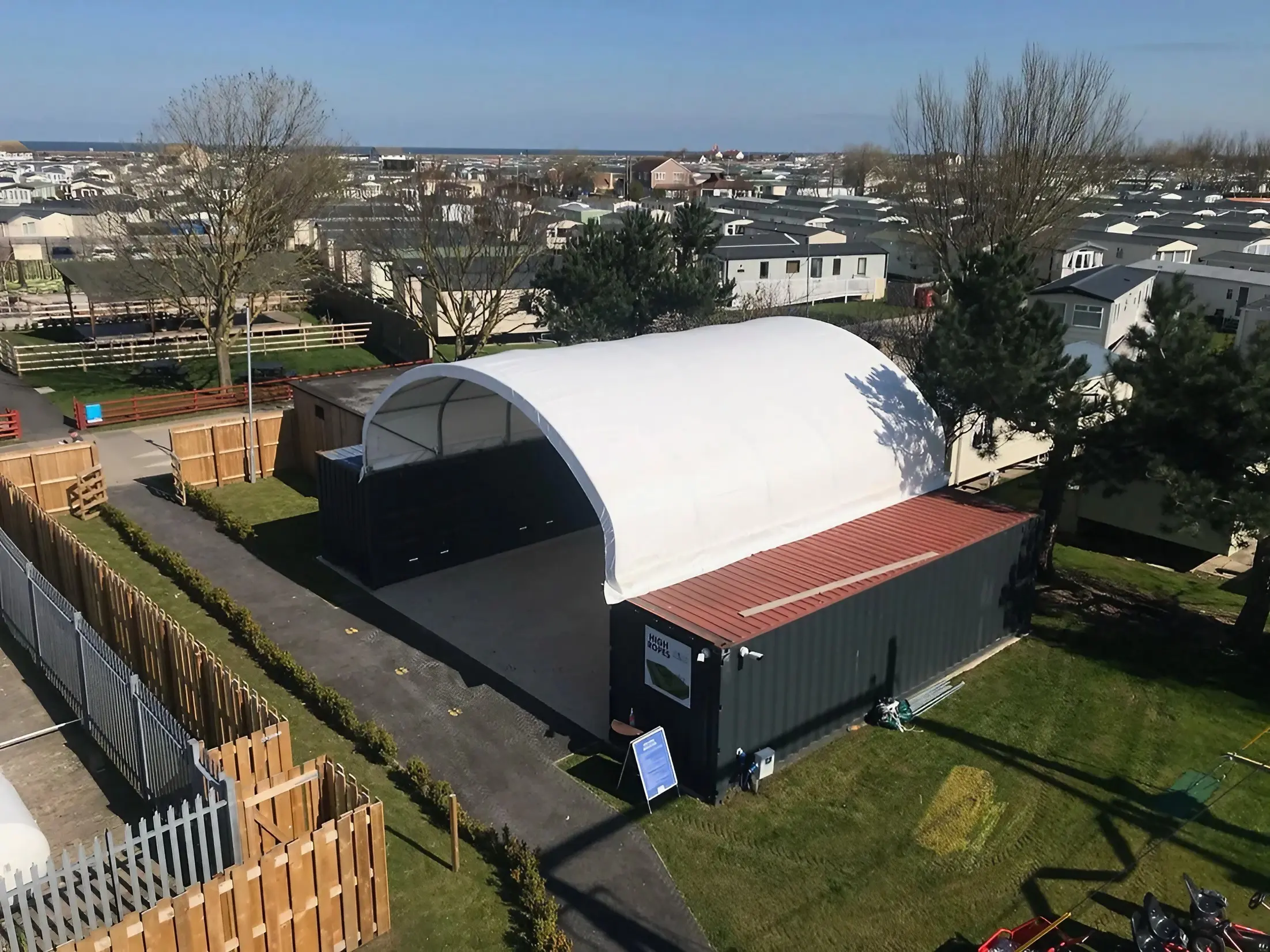
The first is a steel roof structure — fabricated steel beams, purlins, and metal roofing sheets fixed between or over the containers. The second is a PVC container dome — a curved galvanised steel arch frame with a fabric membrane, clamped onto the containers without welding.
Both create valuable covered space. Both protect what's stored underneath. But they differ significantly in cost, installation complexity, portability, approval requirements, and intended lifespan.
For customers who need a permanent building-style structure, a steel roof may be the right solution. For farms, machinery storage, industrial yards, and general weather protection where flexibility and cost matter, a PVC container dome is often the more practical choice.
This article compares both options so you can make an informed decision for your site.
A shipping container roof kit is a roofing system installed between, beside, or over shipping containers to create additional covered storage space.
The term covers two distinct product categories:
Steel container roof
Fabricated steel beams or trusses, purlins, and metal roofing sheets. Usually requires welding or engineered structural connections to the containers. Typically considered a permanent structure.
PVC container dome
A prefabricated kit of curved galvanised steel arches, longitudinal purlins, a PVC membrane cover, and bolt-on clamp hardware. Connects to the containers without welding. Designed as a relocatable shelter system.
Both can be described as a "shipping container roof kit" — but they're different products with different applications, costs, and installation requirements.
Feature | PVC Container Dome | Steel Roof |
Initial Cost | Lower | Higher |
Installation | Fast, bolt-together | More complex |
Welding Required | Not required (Lock-Clamp) | Often required |
Portability | High — relocatable | Low |
Relocation | Dismantle and reinstall | Difficult, often not practical |
Roof Material | PVC membrane | Steel sheeting |
Natural Light | Good — diffused daylight | Limited |
Internal Columns | Usually none | Depends on design |
Structure Type | Relocatable shelter system | Typically permanent |
Approval | May be simpler (check council) | More likely to require approval |
Best Use | Farm, machinery, industrial storage | Permanent building applications |
A steel roof between shipping containers involves significant material and labour costs — structural steel beams or trusses, purlins, roofing sheets, flashing, fabrication, welding, and professional installation. Before a single sheet goes on, the structural work alone is a substantial investment.
A PVC container dome is a prefabricated kit. The arches, purlins, PVC cover, clamps, and bolts arrive in a single crate. You're paying for weather protection and usable covered space, rather than constructing a conventional permanent roof structure.
For farms, machinery storage, construction sites, vehicle protection, and industrial yards — where the primary objective is reliable all-weather cover rather than a permanent building — a PVC dome typically delivers that outcome at a significantly lower total project cost.
Browse Toughcover Australia's container dome shelter range →
One of the most practical advantages of a PVC container dome is the installation process.
A Toughcover dome uses a Lock-Clamp connection system — the base rail clamps directly onto the top of the shipping containers with bolt-on hardware. No welding to the containers. No welding anywhere in the structure. The entire frame assembles with standard spanners.
Unlike fabricated steel container roof systems, which typically require specialist welding equipment, elevated work platforms, and experienced construction crews, a Toughcover container dome is designed for site assembly without specialist trades. Two people can typically complete a full installation in one to two days.
This is particularly relevant for rural and remote sites across Victoria and regional Australia, where organising specialist fabrication crews adds lead time and cost before the roof is even started.
This is one of the most underappreciated advantages of a PVC container dome over a steel roof.
A steel roof fixed between containers is effectively permanent. If the operation expands, the site changes, or the containers need to move, the roof either stays behind or comes down at significant cost.
A PVC container dome is a relocatable shelter system. It dismantles, loads, and reassembles at a new location. The containers move with it. The dome moves with the containers.
Where this matters:
Farming operations expanding into new paddocks or purchasing additional land — the dome relocates rather than being written off.
Construction and civil sites — the covered workshop or storage area moves with the project when the job finishes.
Leased industrial sites — the entire setup relocates at lease end, rather than being left behind as a sunk cost.
Mining and remote sites — temporary covered storage that demobilises cleanly when the project wraps up.
A PVC container dome is an asset that can potentially move with your operation, rather than becoming a permanent fixture of one site.
One reason some customers choose a PVC container dome rather than a conventional steel roof is the relocatable nature of the structure.
Depending on the property, size, intended use, and local regulations, a relocatable container shelter may have simpler approval requirements than a permanent steel roof.
Steel roof: A permanent steel roof between containers is more likely to be treated as building work — similar to a shed or carport structure — meaning building and/or planning approval may be required in most Australian councils.
PVC container dome: Container domes are designed as relocatable shelter systems rather than permanent conventional buildings. In many rural and industrial zones, this distinction can simplify the approval pathway — but this varies significantly between councils and property types.
Permit requirements vary by location. Always confirm requirements with your local council or building surveyor before installation. Toughcover Australia can provide AS/NZS 1170.2 engineering documentation if requested.
A white PVC membrane allows diffused daylight into the shelter, creating a naturally brighter working and storage environment than an opaque steel roof.
This is a practical advantage for:
· Equipment maintenance and workshop use, where visibility matters
· Machinery storage, where you need to see what's inside without switching on lights
· Any application where staff work inside the shelter during daylight hours
Unlike a steel roof which blocks most natural light, the PVC dome keeps the interior usable and well-lit through the day — reducing reliance on artificial lighting.
A container dome uses the shipping containers themselves as the structural base — the arches span from one container to the other, creating fully enclosed covered space between them with no internal support columns.
That means the full width of the shelter — whether 6m, 8m, 10m, or 12m — is usable, clear-span floor space. No posts in the middle. No columns to drive around.
This clear-span design makes container domes well suited for:
· Excavators, tractors, and large agricultural machinery
· Trucks, tippers, and heavy vehicles
· Hay, grain, and bulk storage
· Pallets and building materials
· Any application where unobstructed access across the full width matters
A fabricated steel roof between containers involves long steel beams, purlins, and roofing sheets — components that require appropriate transport, craneage in some cases, and significant on-site fabrication.
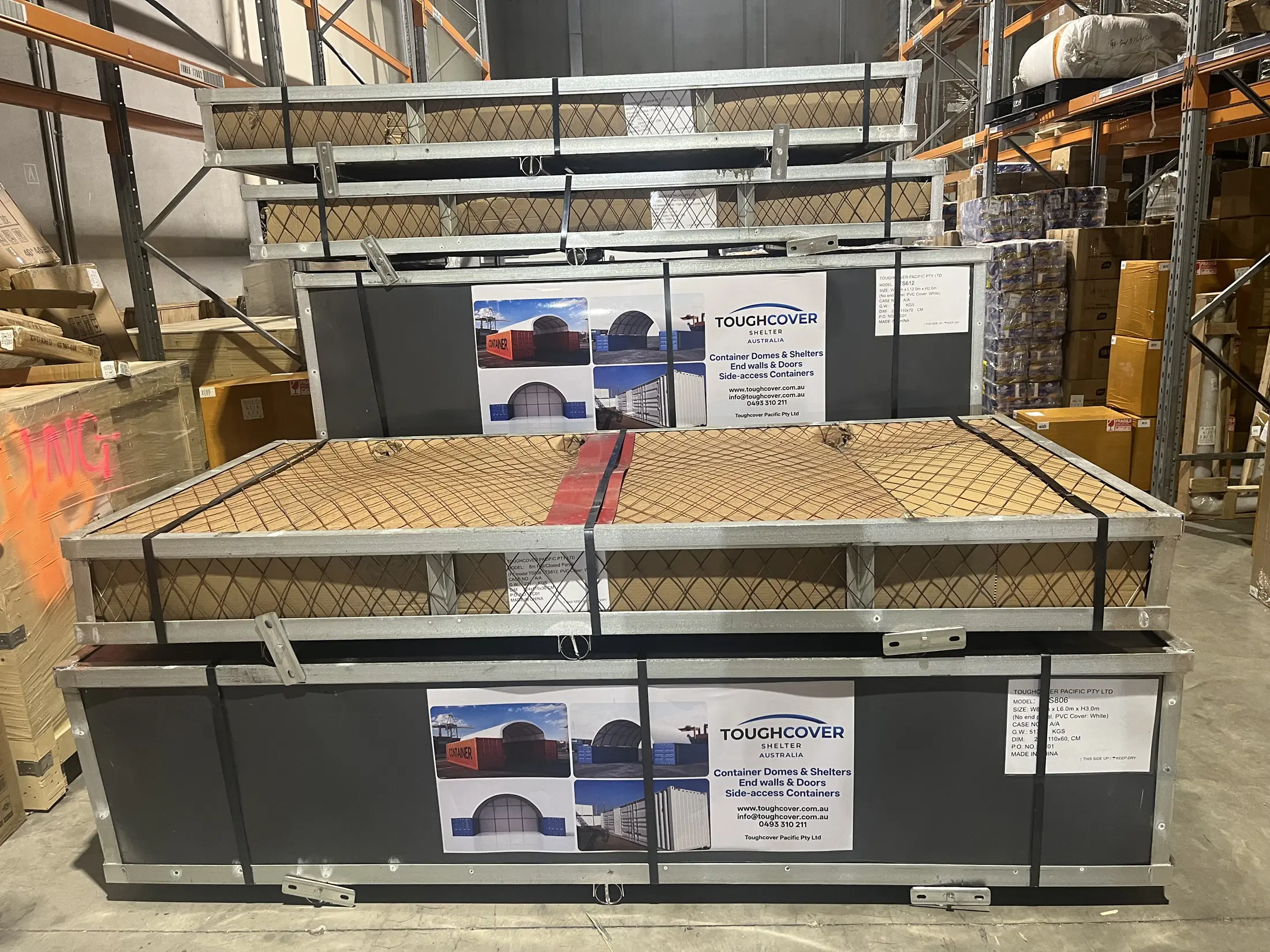
A Toughcover container dome ships as a complete kit in a compact steel crate, with integrated fork pockets for easy handling. It can be freighted to any Australian location and unloaded with a standard forklift.
From our Melbourne warehouse in Scoresby, VIC, we supply dome shelters Australia-wide — VIC, NSW, QLD, SA, WA — with standard freight to most locations.
This article isn't a case against steel roofs. There are applications where a steel roof is clearly the right solution:
· You need a permanent, building-grade structure with traditional roofing appearance
· The structure will be in a fixed location indefinitely with no relocation requirement
· The roof may be subject to mechanical impact from equipment or overhead loads
· The project is already going through formal building approval and a permanent structure is required
· Long-term fixed infrastructure is the priority over flexibility or cost
If these describe your project, a properly engineered steel roof is the appropriate choice. A PVC container dome is not designed to replace permanent building construction.
For most agricultural, construction, and industrial storage applications, a PVC container dome offers a practical balance of protection, cost, and flexibility.
Farms and agricultural properties
Hay storage, tractor and implement shelter, fertiliser cover, livestock feed protection — the dome sits on existing containers without a concrete slab, installs quickly, and relocates if the farm layout changes.
Construction and civil sites
Covered site workshops, equipment storage, materials protection — the dome moves with the project rather than being left behind when the job finishes.
Industrial yards and logistics depots
Overflow storage, vehicle cover, container yard protection near Melbourne's industrial precincts and beyond.
Mining and remote sites
Relocatable covered storage that can be demobilised cleanly, transported, and reinstalled at the next site.
Vehicle and machinery storage
For trucks, caravans, motorhomes, and heavy equipment that won't clear a standard 3m roof — our 4m peak height models are purpose-built for high-clearance requirements.
If the primary objective is affordable, reliable weather protection rather than constructing another permanent building, a PVC container dome is often the more practical solution.
Choosing a PVC dome over a steel roof is only the first decision. The second is which dome.
Not all container domes are built to the same specification — and the differences matter, particularly on larger spans where wind load and structural performance are more demanding.
At Toughcover Australia, our heavy-duty models are built with:
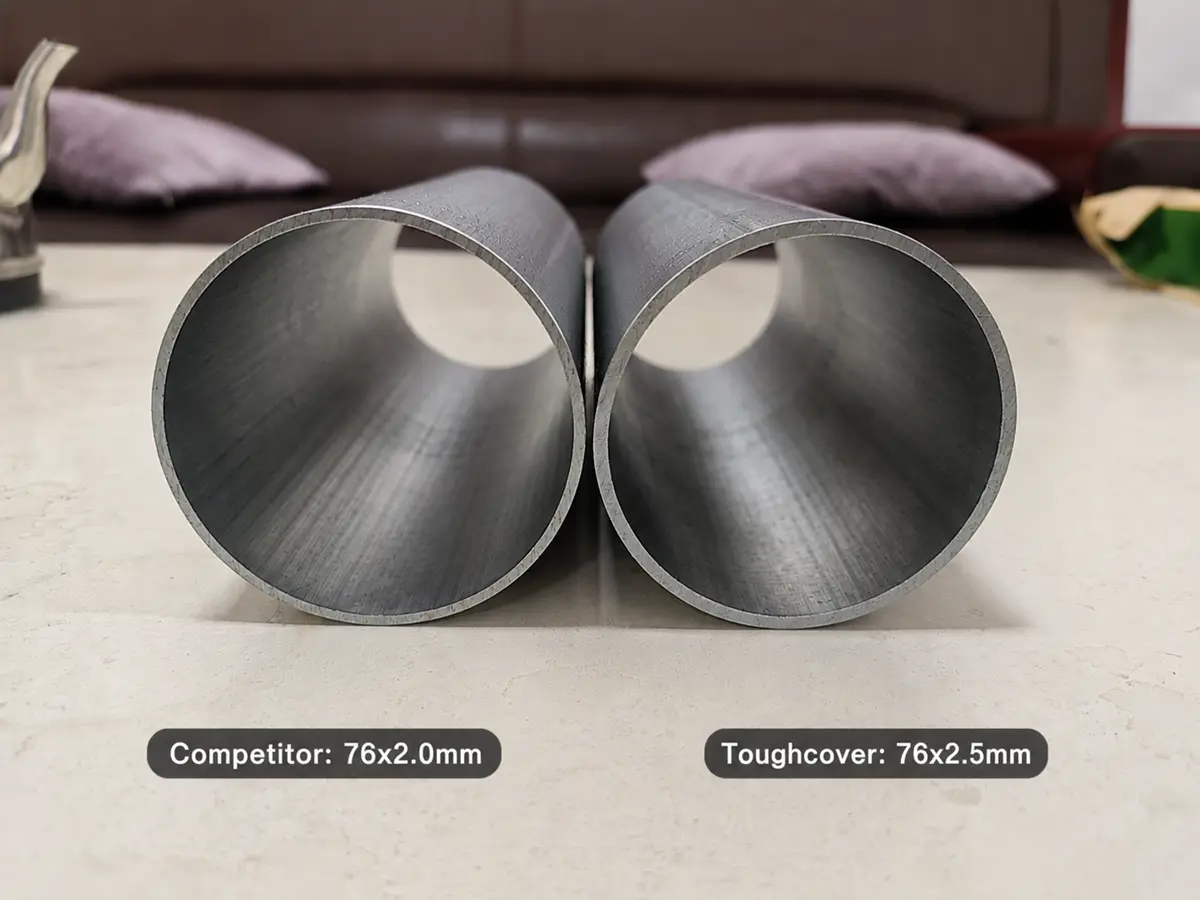
76 x 2.5mm hot-dip galvanised steel arches on our 10m and 12m wide models — 37% more steel per metre than the 1.8mm wall thickness found in some lighter alternatives on the market.
1.5m arch spacing on our 12m wide TS1206 and TS1212 series — tighter than the 2.0m spacing common in comparable products, providing more structural support points across the full length.
Grade 8.8 high-tensile bolts throughout the entire range — double the tensile strength of the Grade 4.8 standard used by most suppliers.
610gsm UV-treated, fire-retardant white PVC cover — designed for long-term outdoor use in Australian conditions.
Lock-Clamp no-weld installation — the entire frame assembles with standard spanners. No welding equipment. No specialist trades required.
AS/NZS 1170.2:2021 certified for Wind Region A — engineered to Australian wind load standards, not just built to look robust.
☛ Why 76x2.5mm steel outperforms 1.8mm →
☛ What "heavy duty" really means →
Choose a PVC container dome if you want:
· Lower upfront cost
· Fast installation without welding
· A relocatable shelter that moves with your operation
· Clear-span storage between shipping containers
· Good natural light inside the shelter
· A practical solution for farm, machinery, construction, or industrial storage
Choose a steel roof if you want:
· A permanent, building-grade structure
· Traditional roofing appearance
· Maximum resistance to mechanical damage
· Long-term fixed infrastructure on freehold land
For most general machinery, farm, and industrial storage applications where flexibility, cost, and fast deployment matter — a PVC container dome offers an excellent balance of protection, strength, and long-term value.
Toughcover Australia is the official Australian branch of Jianqiang Metal Group — a manufacturer with over 20 years of experience producing industrial fabric structures. We supply factory-direct container dome shelters from our Melbourne warehouse in Scoresby, VIC.
Factory direct — no middlemen, no reseller markup
Heavy-duty steel — 76x2.5mm arches on 10m and 12m wide models
Tighter arch spacing — 1.5m centres on selected 12m models
Grade 8.8 bolts — throughout the entire range
610gsm PVC — UV-treated, fire-retardant white
No welding — Lock-Clamp bolt-on installation
AS/NZS 1170.2 certified — Wind Region A
Melbourne stock — ready for dispatch within 3–5 business days
Australia-wide delivery — freight to all states from Scoresby, VIC
Victoria installation — our own crew, not subcontracted
10-year structural warranty
Browse the full range →
Request a Quote →
A shipping container roof kit is a roofing system installed between, beside, or over shipping containers to create additional covered storage space. The term covers two main product types: a fabricated steel roof using beams, purlins, and metal sheeting; or a PVC container dome using prefabricated steel arches, a fabric membrane, and bolt-on clamp hardware. Both create usable covered space, but they differ significantly in cost, installation, portability, and intended use.
Yes. Two common approaches are a fabricated steel roof structure or a PVC container dome shelter. A PVC dome uses curved galvanised steel arches that span from one container to the other, clamped on with bolt-on hardware — no welding required. The result is clear-span covered storage between the two containers with no internal support columns.
Generally yes. A steel roof between containers involves structural steel fabrication, welding, and professional installation — significant material and labour costs. A PVC container dome arrives as a prefabricated kit and assembles with standard spanners. For most farm, machinery, and industrial storage applications, a dome delivers reliable weather protection at a lower total project cost than a fabricated steel roof.
Permit requirements vary by location, property type, and intended use. Container domes are designed as relocatable shelter systems rather than permanent buildings, which may result in simpler approval requirements in some areas compared to permanent steel roof structures. Always confirm requirements with your local council or building surveyor before installation. Toughcover Australia can provide AS/NZS 1170.2 engineering documentation if requested.
No. Toughcover Australia's container dome shelters use a Lock-Clamp connection system — the base rail clamps directly onto the shipping containers with bolt-on hardware. No welding equipment is required anywhere in the structure. The entire frame assembles with standard spanners included in the kit.
Most Toughcover dome shelters are completed in one to two days with two people using standard spanners. Two spanner kits are included with every order. For customers in Victoria, professional on-site installation is also available as an optional extra.
Yes. A container dome dismantles and reassembles at a new location. The Lock-Clamp system attaches to the containers without drilling or welding, so both the dome and containers can be moved without damage to either. This makes a container dome a reusable asset rather than a permanent fixture — particularly relevant for leased sites, farming operations, construction projects, and any application where future relocation is possible.
Toughcover Australia's dome shelters are designed for standard 20ft and 40ft shipping containers in both General Purpose (GP) and High Cube (HC) configurations. Model widths range from 6m to 12m, covering single and double-container setups.
A steel shed is a fully enclosed, free-standing permanent structure built from the ground up. A container dome uses existing shipping containers as the structural base, with the arch frame spanning between them. The dome is relocatable, installs faster, requires no concrete slab, and is generally lower in total project cost — but is not a fully enclosed building.