If you're looking for covered storage or a site workshop, the default assumption is usually a steel shed. It's what's been used on Australian farms and industrial sites for decades. It feels permanent, solid, and familiar.
But for a growing number of agricultural operations, construction sites, and industrial businesses, container dome shelters are replacing steel sheds as the practical choice — not because they're trendier, but because they make more sense when you run the numbers.
This article compares both options across the factors that matter most: cost, installation, permits, structural reliability, and long-term flexibility. It won't tell you one is always better than the other — because it depends entirely on what your site actually needs.
The upfront price difference between a container dome shelter and a steel shed varies significantly depending on size and specification — but for comparable covered area, a dome shelter typically comes in at a lower total project cost.
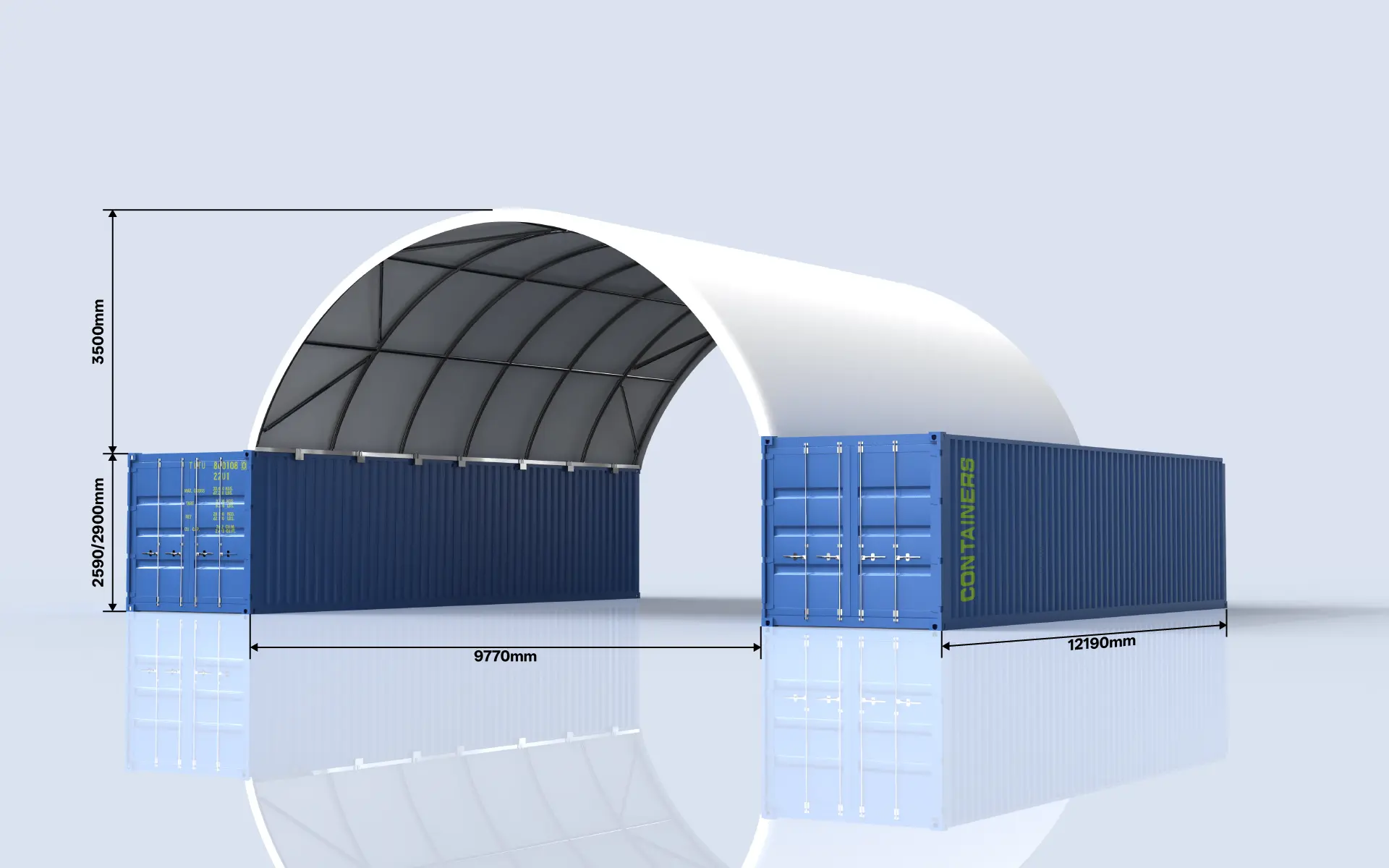
A key reason: a container dome shelter uses your existing shipping containers as the foundation. The containers become the structural base, so you're not paying for a full slab, footings, or a freestanding structural frame from scratch.
A comparable steel shed requires the complete structural framework — posts, purlins, cladding, and usually a concrete slab. Before a single tool hits the ground, the material and groundwork costs are already substantial.
For a 120m² covered area — equivalent to our TS1012 (10m x 12m) — the all-in cost comparison including installation, groundwork, and materials often favours the dome shelter by a meaningful margin.
This is where the difference becomes most obvious on a practical level.
A container dome shelter is designed for site assembly without specialist trades. The Toughcover Lock-Clamp system is entirely no-weld — every component connects with standard spanners. 2-4 people can typically complete a full installation in 1 to 3 days. No cranes. No welding contractors.
Two free spanner kits are included with every Toughcover shelter. The installation manual walks through each step in sequence.
A steel shed is a different proposition. Most require professional erection crews, and depending on size and complexity, cranes or elevated work platforms are often involved. In Australia, qualified labour isn't cheap — and erection costs on a larger steel shed can add $5,000–$15,000 or more to the project budget before you've paid for the slab.
For sites in regional areas where specialist trades require travel, accommodation, and lead time, the gap widens further.
Planning and permit requirements vary significantly between councils and between property types — so always check with your local council before proceeding with either structure. The following is general guidance only.
Container dome shelters are often classified as temporary or relocatable structures because they mount on containers rather than being permanently fixed to the ground. In many rural and industrial zones, this can simplify the approval process — though this is not universal and depends on your specific council and zoning.
Steel sheds are typically classified as permanent structures. That usually means a formal development application, engineering certification, and in some cases, heritage or environmental assessments depending on the site. The approval timeline alone can add weeks or months to a project.
For operations that need covered storage quickly — a construction project starting in six weeks, a harvest season approaching, a new depot opening — the permit pathway matters as much as the structure itself.
A common concern from buyers new to dome shelters is whether they're structurally comparable to a steel shed. It's a fair question.
The answer depends entirely on the specification. A well-engineered dome shelter is a serious structure — not a temporary tarpaulin on a frame.
The Toughcover TS1012 is a useful reference point:
· 76mm OD x 2.5mm wall thickness hot-dip galvanised steel — 37% more steel per metre than the 1.8mm tube common in budget alternatives
· 7 arch sets at 1.5m centres across the full 12-metre length — tighter spacing than most comparable shelters
· Grade 8.8 high-tensile bolts throughout — double the tensile strength of the Grade 4.8 standard
· AS/NZS 1170.2:2021 certified — engineered to Australian wind load standards for Wind Region A
· 10-year structural warranty
This isn't a lightweight seasonal cover. It's a heavy industrial structure rated for Australian conditions — suitable for machinery storage, site workshops, and long-term outdoor use.
That said, steel sheds can offer advantages in specific applications — fully enclosed cladding, greater height clearance on taller spans, or configurations that a dome profile simply can't match. The right choice depends on what you're actually storing and how you're using the space.
This is the clearest advantage a container dome shelter holds over a steel shed, and it's often the deciding factor for businesses that operate across multiple sites or expect their needs to change.
A steel shed is permanent. Once it's built, relocating it is expensive, disruptive, and often not practical — it typically means demolition and a new build at the next site.
A container dome shelter can be dismantled, loaded, and reassembled at a new location. The containers move with it. The whole setup relocates without the structure being written off.
Practical examples where this matters:
Farm expansion — A shelter installed on containers in one paddock can move to a new storage area without losing the asset.
Construction and civil projects — A site workshop or covered storage area moves with the project as it progresses. When the job finishes, the shelter moves to the next one.
Mining and infrastructure — Remote sites often need temporary covered storage that can be demobilised when the project wraps up. A permanent shed is a sunk cost. A dome shelter is a reusable asset.
Business relocation — If the operation moves premises, the shelter comes with it.
For businesses that can't predict where they'll be operating in five years, permanence isn't always an asset.
Neither option is universally better. The right choice depends on your site, your timeline, and what you're planning to do with the space.
A steel shed is likely the better choice if:
· You need a fully enclosed, permanently clad structure
· The location is fixed for the foreseeable future
· Height clearances or span widths exceed what a dome profile can achieve
· Council approval and construction lead time aren't constraints
A container dome shelter is likely the better choice if:
· You need covered storage faster than a shed build allows
· Lower total project cost matters
· You have existing containers that can serve as the base
· Future relocation is possible or likely
· DIY installation is preferable to managing a construction crew
· You need a structure that can expand as the operation grows
Feature | Container Dome Shelter | Steel Shed |
Initial Cost | Lower — uses existing containers | Higher — full structural framework required |
Installation Cost | Low — DIY friendly, no specialist trades | High — professional crews, often cranes |
Installation Time | 1–3 days typical | Weeks, depending on size and complexity |
DIY Capability | Yes — no-weld Lock-Clamp system | Generally no — specialist erection required |
Permit Complexity | Often simpler (check with council) | Usually formal DA required |
Relocatable | Yes — dismantles and reassembles | No — effectively permanent |
Expandable | Yes — additional bays possible | Limited — major structural work required |
Downtime During Install | Minimal | Significant |
Uses Existing Containers | Yes — containers are the foundation | No |
Long-Term Flexibility | High | Low |
A Victorian transport depot needed 120m² of covered storage for vehicles and freight equipment — fast, with no concrete slab and no permanent footprint on a leased site.
The TS1012 (10m x 12m x 3.5m) was installed across two existing 40ft containers in two days by a two-person crew. Total covered area: 120m². Kit weight: 1,150kg — significantly heavier than budget alternatives at the same size, reflecting the 76 x 2.5mm steel frame and Grade 8.8 bolt specification throughout.
AS/NZS 1170.2:2021 certified for Wind Region A. Ten-year structural warranty. When the lease ends, the shelter relocates with the containers.
View full TS1012 specs and pricing →
For many Australian farms, construction sites, and industrial operations, the question is no longer whether a dome shelter can replace a steel shed.
The real question is whether the additional cost and permanence of a steel shed is justified for your specific application.
If flexibility, speed, and total project cost matter — and if you have existing containers on site — a heavy-duty container dome shelter is worth a serious look before you commit to a slab.
☏ 0493 310 211
@ info@toughcover.com.au
Request a Quote →
A well-engineered dome shelter is a serious structure. The Toughcover TS1012, for example, uses 76 x 2.5mm heavy-wall galvanised steel, Grade 8.8 bolts, and is certified to AS/NZS 1170.2:2021 Wind Region A. It's rated for long-term outdoor use in Australian conditions — not a temporary cover. Steel sheds can offer advantages in specific configurations, but a quality dome shelter is fully comparable for most agricultural, industrial, and logistics applications.
Requirements vary by council and zoning. Container dome shelters are often classified as temporary or relocatable structures, which can simplify the approval process in some situations — but this isn't universal. Always check with your local council before installation. Toughcover can provide AS/NZS 1170.2 engineering documentation if requested.
Yes. A container dome shelter dismantles and reassembles at a new location. The Lock-Clamp mounting system attaches to the containers without drilling or welding, so both the shelter and containers can be moved without damage to either. This is one of the key advantages over a permanent steel shed.
Most Toughcover shelters are completed in one to two days with two people using standard spanners. Two spanner kits are included with every order. No welding, no cranes, and no specialist trades are required.
The TS1012 (10m x 12m) covers 120m² — comparable to a medium farm machinery shed. The TS1212 (12m x 12m) covers 144m² for larger requirements. Both use existing 40ft shipping containers as the base structure.