When most buyers compare container dome shelters, they look at three things: price, dimensions, and a product photo. If the specs say 12 metres wide and the photo shows a white dome on two containers, it looks the same as every other 12-metre dome on the market.
But weigh them side by side and the difference becomes hard to ignore.
Two shelters. Same footprint. One ships at 1,355kg. The other at 1,050kg. That's 305kg of difference on a structure that's supposed to protect your most valuable site assets.
So what is that extra weight actually telling you?
Australia isn't a forgiving environment for outdoor structures.
Wind gusts across open farmland in Victoria and South Australia regularly exceed 80km/h. Coastal sites deal with salt-laden air that accelerates corrosion on anything that isn't properly protected. Tropical regions in Queensland and the Northern Territory bring cyclonic conditions, sustained rainfall, and humidity that tests every joint and fastener in a structure. And across the inland regions, UV exposure degrades materials faster than almost anywhere on earth.
A container dome shelter sitting on an exposed agricultural site in the Wimmera, or on an industrial yard near the Port of Melbourne, is working hard every day it's standing. The structure protecting $200,000 worth of machinery or freight needs to be built for that reality — not for a product photo in calm conditions.
When a dome ships heavier than its competitors, that weight usually reflects specific engineering decisions made for exactly these conditions.
The most direct reason one dome shelter weighs more than another is the amount of steel in it.
Every container dome uses 76mm outer diameter tube for the main arches. From the outside, a 76mm tube is a 76mm tube — they all look the same. But the wall thickness is where the real difference lives.
The Toughcover TS1212(3m) uses 76 x 2.5mm wall thickness throughout. Many alternatives in the market use 76 x 1.8mm or 2.0mm.
Run the numbers on what that means in practice:
· 76 x 2.5mm tube: 57.1mm² steel cross-section per tube
· 76 x 1.8mm tube: 41.6mm² steel cross-section per tube
· Difference: 37% more steel per metre of arch tube
Across nine full arches on a 12-metre wide, 12-metre long structure, that 37% compounds into hundreds of kilograms. And more steel per arch means more resistance to bending — the force that does the most damage to a large-span structure when wind loads build up.
The TS1212(3m) ships at 1,355kg. Comparable shelters at the same dimensions typically come in at 1,050–1,200kg. That 155–305kg gap is almost entirely steel.
☛ Full technical breakdown: 76x2.5mm vs 1.8mm steel →
Steel thickness isn't the only variable. The number of arches and the spacing between them also contribute to total weight — and to structural performance.
The TS1212(3m) uses 9 arch sets at 1.5-metre centres across the full 12-metre length. Many comparable shelters use 7 arches at 2.0-metre centres.
More arches means:
· More steel in the overall structure — direct weight contribution
· More support points across the roof span
· Shorter unsupported distance between each contact point
· Better load distribution when wind pressure builds across the full width
At 12 metres wide, a longer unsupported span between arches means more flex in the roof under load. The cover loses tension. The purlins carry more bending stress. And when one arch is under pressure, the next one is further away to share the load.
Two extra arches and tighter 1.5-metre spacing isn't just a weight difference — it's a structural design decision that reflects how seriously the shelter takes its job.
A heavier dome shelter is usually a better-built dome shelter. But weight alone doesn't tell you everything. It's a useful first filter — and when the numbers are significantly different between two shelters of the same size, it's worth asking why.
The full picture requires looking at:
Tube wall thickness — Is it 2.5mm or 1.8mm? The outer diameter is always the same 76mm, so this question has to be asked directly.
Arch count and spacing — How many arches? At what centres? These numbers aren't always in the marketing material.
Bolt grade — Grade 8.8 or Grade 4.8? Most budget shelters use 4.8 as standard. Grade 8.8 has double the tensile strength at every connection point.
Engineering documentation — Is the shelter certified to AS/NZS 1170.2? For which wind region? A certification claim is very different from documented engineering.
Total kit weight — If the supplier publishes it. If they don't, that's worth noting.
Weight is often the quickest indicator available — because it's a number that reflects all of these decisions at once. A shelter built with heavier steel, more arches, and higher-grade hardware will weigh more. A shelter built to a price will weigh less.
A lighter dome shelter at a lower price is an appealing proposition. The saving might be $300, $500, or $800 — somewhere between 5% and 15% of the total purchase price.
But consider what's sitting under the dome.
A farm operation's header: $150,000–$400,000. A fleet of vehicles at a transport depot. An excavator and telehandler on a construction site. Industrial inventory that took months to source. None of these assets are cheap to replace, insure, or put out of action.
A container dome shelter is an asset protection investment. The machinery it covers is worth many times the cost of the shelter itself. Viewed against the value of what's underneath, the difference between a well-built dome and a lightweight alternative is a very small premium.
And if the dome fails during a serious wind event — which is the scenario it's designed to prevent — the cost isn't just the shelter. It's the machinery underneath, the insurance claim, the operational downtime, and the process of starting again.
When evaluating container dome shelters, here's the checklist worth working through:
✓ Tube diameter — 76mm OD is standard. Confirm it's not a smaller profile.
✓ Tube wall thickness — 2.5mm vs 1.8mm vs 2.0mm. Ask directly if it's not published.
✓ Arch spacing — 1.5m or 2.0m centres? More arches across the same length is a structural advantage.
✓ Number of arches — Relates directly to span length and load distribution.
✓ Bolt grade — Grade 8.8 or Grade 4.8? Ask for the spec sheet.
✓ Engineering documentation — AS/NZS 1170.2 certified? For which wind region specifically?
✓ Total kit weight — Published shipping weight is one of the most useful single numbers available. If two shelters are the same size and one is 300kg lighter, the question is worth asking.
Weight won't tell you everything. But it's a fast, practical indicator of whether a dome shelter has been built with structural substance or built to a price.
Feature | Toughcover TS1212(3m) | Typical Lightweight Alternative |
Steel Tube | 76mm x 2.5mm wall | 76mm x 1.8mm–2.0mm wall |
Steel per metre | +37% more steel | Baseline |
Arch Spacing | 1.5m | 2.0m |
Number of Arches | 9 | 7 |
Bolt Grade | Grade 8.8 | Often Grade 4.8 or unspecified |
Total Kit Weight | 1,355kg | 1,050–1,200kg |
Wind Certification | AS/NZS 1170.2 — Wind Region A | Varies |
Structural Warranty | 10 years | Varies |
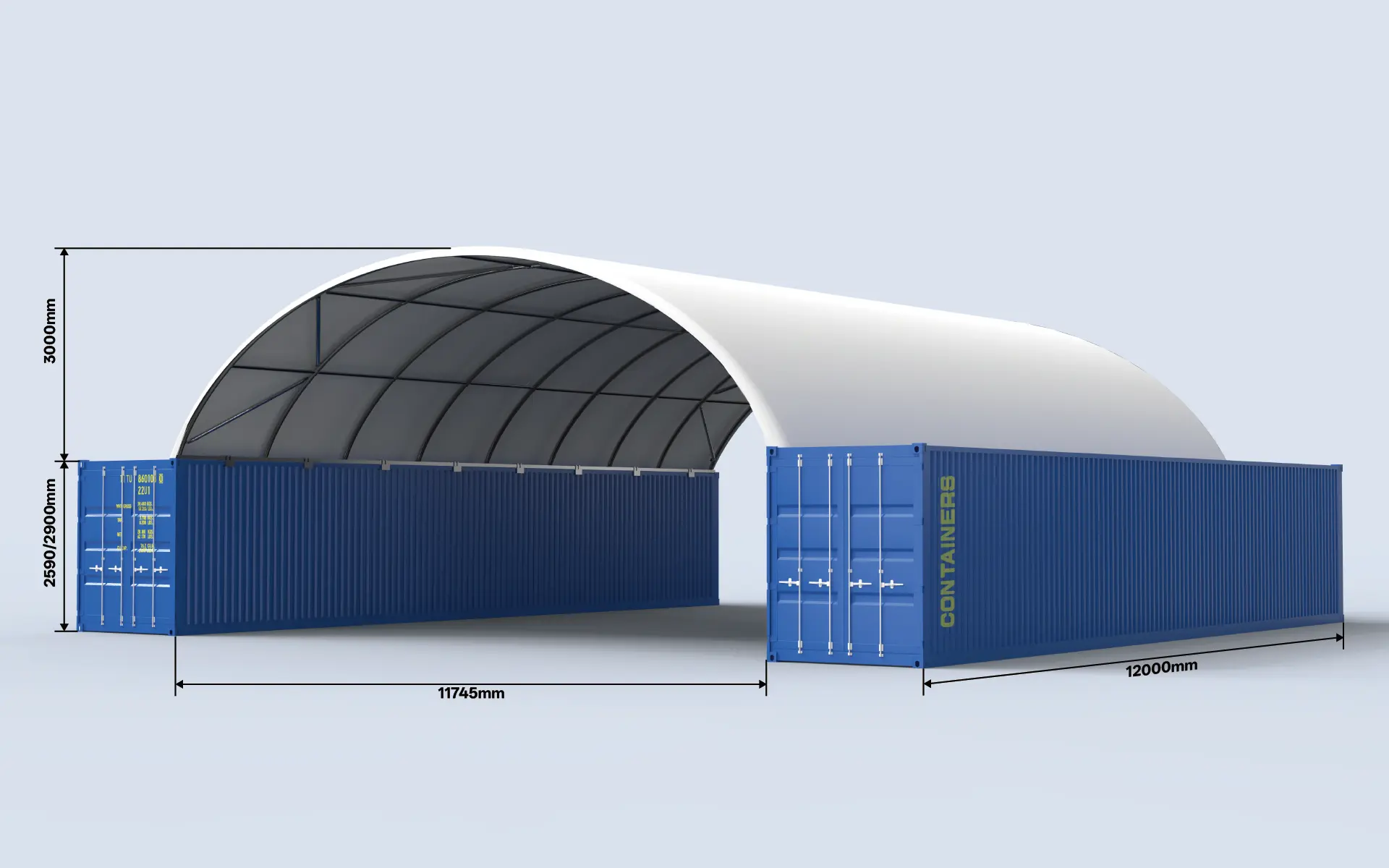
The TS1212(3m) covers 144m² across two 40ft containers. It uses the Lock-Clamp no-weld installation system — assembled with standard spanners, no specialist trades required. Professional installation is available as an optional extra for customers in Victoria.
View TS1212(3m) full specs and pricing →
When comparing container dome shelters, weight should never be viewed as a disadvantage or an inconvenience at the freight quote stage.
In most cases, weight is one of the clearest indicators of the material, engineering, and structural integrity built into the dome. It reflects how much steel is in the arches, how many arches there are, and whether the supplier has made the same engineering decisions across the whole structure.
Because when the assets underneath are worth protecting, what matters most isn't how light a dome shelter is. It's how well it holds when the weather doesn't cooperate.
☏ 0493 310 211
@ info@toughcover.com.au
Request a Quote →
Browse the full container dome shelter range →
A heavier dome shelter typically contains more steel — either through thicker tube walls, more arch sets, or both. More steel per arch means greater resistance to bending under wind load. More arches means shorter unsupported spans and better load distribution across the roof. Total kit weight is one of the most practical indicators of structural substance when comparing shelters of the same dimensions.
Both have a 76mm outer diameter and look identical from the outside. The difference is wall thickness — 2.5mm vs 1.8mm. The 2.5mm tube has 37% more steel per metre, a larger cross-section area, and significantly greater resistance to bending. On a 12-metre arch under wind load, that structural difference is meaningful.
The Toughcover TS1212(3m) uses 9 arch sets at 1.5-metre centres across the 12-metre length. Many alternatives use 7 arches at 2.0-metre centres. More arches across the same span means more support points, shorter unsupported sections of roof, and better load distribution under wind pressure.
AS/NZS 1170.2:2021 is the Australian and New Zealand standard for wind actions on structures. A shelter certified to this standard has been engineered and verified against specific wind load requirements. Toughcover dome shelters are certified for Wind Region A, which covers the majority of populated areas in Australia including Victoria, New South Wales, Queensland, and South Australia.
Yes. Professional on-site installation is available as an optional extra for customers in Victoria. Contact us with your site location and model details for a full delivered and installed price.