Walk through any industrial equipment website and you'll find the same two words attached to almost every product: heavy duty.
Heavy duty container dome. Heavy duty steel frame. Heavy duty PVC cover. Heavy duty everything.
The problem is that "heavy duty" isn't a specification. It's a description — and it doesn't tell you anything measurable about the structure you're considering putting your machinery, vehicles, or inventory under.
Two 12-metre wide container dome shelters can look almost identical in a product photo. Same white PVC cover. Same arched profile. Same two blue containers underneath. One is genuinely heavy duty. The other is using the same language to describe a lighter, thinner structure built to a lower price point.
So how do you tell them apart?
You look at the numbers.
The main arch tube is the most important structural component in a container dome shelter. It's what carries the load when wind pressure builds up across the roof, and it's the first thing worth scrutinising when a supplier claims heavy duty construction.
Most dome shelters on the Australian market use 76mm outer diameter (OD) tube for the main arches. That's a consistent standard across the industry — and it's where the comparison usually stops, because 76mm sounds substantial and the tubes look the same from the outside.
But the outer diameter is only half the story. The wall thickness — the steel between the outside of the tube and the hollow centre — is where the real difference lives.
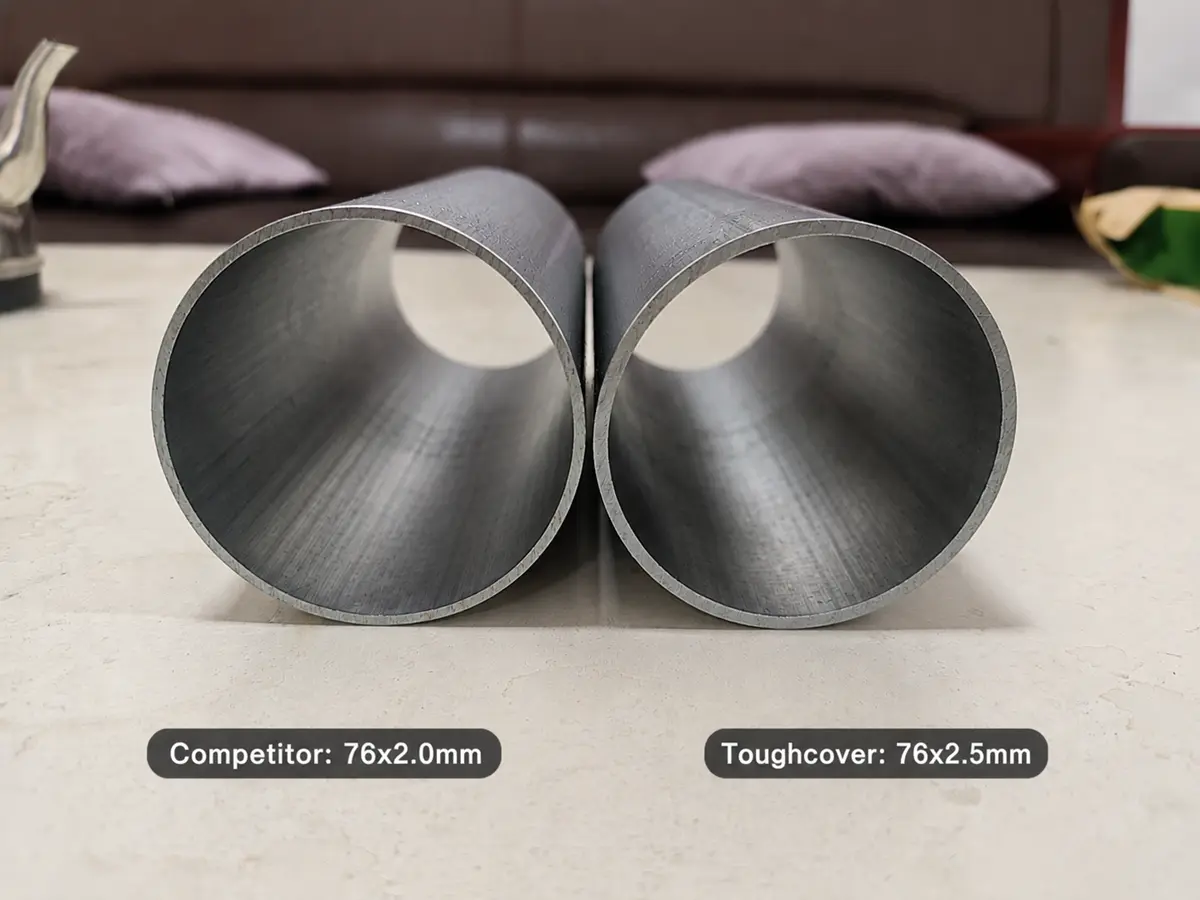
The Toughcover TS1212(3m) uses 76mm OD x 2.5mm wall thickness throughout every arch. Some alternatives in the market use the same 76mm outer diameter but with 1.8mm or 2.0mm walls.
Put two lengths of tube side by side and you cannot tell them apart from the outside. Same 76mm profile. Same galvanised finish. But cut a cross-section and the difference is clear — the 2.5mm wall carries 37% more steel per metre than the 1.8mm alternative.
On a 12-metre arch under wind load, that additional steel translates into greater resistance to bending at the crown and the base. More material in the wall means more structural substance — and a shelter that holds its geometry under sustained pressure rather than starting to deform.
When a supplier says "heavy duty steel frame", ask: what is the outer diameter and what is the actual wall thickness?
☛ Full technical breakdown: 76x2.5mm vs 1.8mm steel →
Steel tube thickness is the most discussed specification. Arch spacing is the one most buyers never think to ask about — and it has a significant impact on how a dome shelter behaves under load.
The TS1212(3m) uses 9 arch sets at 1.5-metre centres across the full 12-metre length. Many comparable shelters use 7 arches at 2.0-metre centres.
Here's why that difference matters:
Every arch is a structural contact point — a location where the roof load transfers into the frame. A wider spacing between arches creates a longer unsupported section of roof between each contact point. Under wind load, that unsupported span deflects more. The PVC cover loses tension. The purlins carry more bending stress. And the load concentration at each arch increases because there are fewer arches sharing the total structural demand.
Tighter arch spacing — 1.5m instead of 2.0m — means more contact points across the same length, shorter unsupported spans, and better distribution of load across the full structure. It also means more steel in the frame overall, which contributes directly to total kit weight.
When a supplier describes their dome as heavy duty, ask: what is the arch spacing, and how many arches are included for my shelter length?
There's a direct relationship between arch count, arch spacing, and total structural steel:
Closer spacing → More arches → More steel in the structure → Higher total kit weight
The TS1212(3m) has 9 arches — approximately 29% more arch frames than a typical 7-arch alternative at the same 12-metre length. That's not a claim about 29% greater structural strength — structural performance depends on a range of engineering variables. But it does mean the TS1212(3m) contains more arch frames, more structural members, and more steel throughout.
The total kit weight of the TS1212(3m) is 1,355kg. Comparable alternatives at the same dimensions typically come in at 1,050–1,200kg.
That 155–305kg gap doesn't appear by accident. It's the accumulated result of thicker steel walls, more arch sets, additional purlins, and heavier hardware throughout. Weight alone isn't a guarantee of structural performance — but when a shelter ships significantly lighter than a comparable product at the same size, it's worth asking where the difference went.
☛ Why dome shelter weight matters more than most buyers realise →
A heavy-duty structure is only as reliable as its connections. And the connections in a container dome shelter are bolts.
Toughcover uses Grade 8.8 high-tensile bolts throughout every dome shelter — at every arch base, every purlin connection, and every Lock-Clamp mounting point.
Buyers should always ask their supplier what bolt grade is specified. The answer matters:
Property | Grade 4.8 | Grade 8.8 |
Tensile Strength | 400 MPa | 800 MPa |
Yield Strength | 320 MPa | 640 MPa |
Proof Load Stress | 310 MPa | 580 MPa |
Under dynamic wind load — the repeated stress cycling a dome shelter experiences over years of outdoor use — fastener grade affects long-term joint integrity. A frame built with heavier steel and more arches but connected with underspecified bolts isn't fully heavy duty. Heavy duty should apply to the whole structure, not just the main tubes.
Ask: what bolt grade is used, and is it clearly specified on the product documentation?
The PVC cover on a container dome shelter isn't just a weatherproof skin. It's a structural element — it maintains tension across the arch frame and contributes to the overall rigidity of the dome profile.
Toughcover supplies a 610gsm heavy-duty white PVC cover with every dome shelter. The specification matters:
· 610gsm — the weight per square metre of the fabric, indicating material density and thickness
· UV-treated — stabilised against the UV degradation that's particularly aggressive in Australian conditions
· Fire-retardant — meets industrial site requirements
· White — reflects heat rather than absorbing it, keeping the internal temperature of the dome significantly lower than darker alternatives
When a supplier describes their cover as "heavy-duty fabric" or "industrial PVC" without specifying the gsm rating, ask for the number. A 400gsm cover and a 610gsm cover are very different products — and the difference shows up in how long the cover lasts outdoors in Australian conditions.
Measurable specifications matter. But specifications without engineering are numbers on a page.
Every Toughcover dome shelter is designed to AS/NZS 1170.2:2021 — the Australian and New Zealand standard for wind actions on structures — certified for Wind Region A, covering the majority of populated areas in Australia including Victoria, New South Wales, Queensland, and South Australia.
That certification means the shelter has been engineered and verified against specific wind load requirements for Australian conditions — not just built to look robust. It's the difference between a structure that's been designed for the environment and one that's been designed to a price.
Before purchasing any dome shelter for an exposed site — open farmland in Victoria, an industrial yard near the coast, a construction depot in regional Queensland — check whether the supplier can provide engineering documentation for your specific wind region and terrain category.
Ask: is the shelter certified to AS/NZS 1170.2, and for which wind region specifically?
Before accepting any "heavy duty" claim at face value, work through these questions:
✓ Steel tube diameter — What is the OD? (76mm is standard for most models)
✓ Steel wall thickness — Is it 2.5mm, 2.0mm, or 1.8mm? Ask directly.
✓ Arch spacing — 1.5m or 2.0m centres?
✓ Number of arches — How many for your shelter length?
✓ Bolt grade — Grade 8.8 or 4.8? Is it specified on the documentation?
✓ PVC cover specification — What is the gsm rating?
✓ Total kit weight — What does the complete package weigh?
✓ Engineering certification — AS/NZS 1170.2 certified? For which wind region?
A supplier that can answer every one of these questions clearly and without hesitation is demonstrating something meaningful. A supplier that responds with "heavy duty" and moves on is telling you something too.
Specification | Toughcover TS1212(3m) | What to Check |
Main Arch Tube | 76mm OD x 2.5mm wall | Diameter AND wall thickness |
Arch Spacing | 1.5m | Ask for actual spacing |
Number of Arches | 9 | Compare for same shelter length |
Structural Bolts | Grade 8.8 | Ask supplier to confirm |
PVC Cover | 610gsm UV & fire-retardant | Check gsm rating |
Wind Engineering | AS/NZS 1170.2 — Wind Region A | Confirm wind region |
Total Kit Weight | 1,355kg | Ask for verified kit weight |
Structural Warranty | 10 years | Ask what's covered |
The TS1212(3m) covers 144m² across two 40ft containers. It's available from our Melbourne warehouse in Scoresby, VIC, with Australia-wide freight and professional installation available across Victoria.
View full TS1212(3m) specs and pricing →
"Heavy duty" should be demonstrated, not just claimed.
A genuinely heavy-duty container dome shelter can show you exactly where the extra material and engineering come from — thicker steel walls, closer arch spacing, more structural members, high-tensile fasteners, and certification to Australian wind standards.
For Australian buyers protecting machinery, vehicles, equipment, or inventory worth tens or hundreds of thousands of dollars, comparing these specifications before comparing price leads to a more informed decision.
Because the dome shelter's job isn't to look heavy duty in a product photo. It's to hold when the weather doesn't cooperate.
☏ 0493 310 211
@ info@toughcover.com.au
Browse the full dome shelter range →
For a container dome shelter, heavy duty should be measurable — not just a description. Key indicators include steel wall thickness (2.5mm vs 1.8mm), arch spacing (1.5m vs 2.0m), number of arches, bolt grade (8.8 vs 4.8), PVC cover weight (610gsm), and total kit weight. A supplier that can answer all of these questions clearly is demonstrating something meaningful.
All 76mm OD tubes look identical from the outside. The wall thickness — the steel between the surface and the hollow centre — determines how much material is actually in the arch. A 76x2.5mm tube carries 37% more steel per metre than a 76x1.8mm tube, with significantly greater resistance to bending under wind load.
Grade 8.8 bolts have twice the tensile strength (800 MPa vs 400 MPa) and twice the yield strength of Grade 4.8 fasteners. In a dome shelter frame subjected to repeated wind load over years of outdoor use, the bolt grade at every connection point affects long-term structural integrity.
Arch spacing determines the unsupported distance between structural contact points on the roof. Closer spacing — 1.5m vs 2.0m — means more support points, shorter unsupported spans, and better load distribution under wind pressure. The TS1212(3m) uses 9 arch sets at 1.5m centres for a 12-metre long shelter.
Yes. The TS1212(3m) is certified to AS/NZS 1170.2:2021 for Wind Region A, covering the majority of populated areas in Australia. Engineering documentation is available on request.
Ask these eight questions: tube diameter, wall thickness, arch spacing, arch count, bolt grade, PVC cover gsm, total kit weight, and AS/NZS 1170.2 certification. A supplier that answers all eight clearly is demonstrating structural transparency. One that deflects to marketing language is telling you something too.